
Agri-environmental monitoring
Agriculture utilises the natural resources of soil, water, air and biodiversity to produce agricultural goods, a process that is also associated with environmental pollution. Agri-environmental monitoring data make it possible to trace developments in the ecological services that agriculture provides.
Environmental performance of agriculture
Using national, regional and farm-specific indicators, agri-environmental monitoring provides a basis for assessing agricultural policy and monitoring the environmental performance of agriculture. The practice is based on the Ordinance on the Evaluation of Sustainability in Agriculture.
Agri-environmental indicators identify trends and provide data for in-depth analyses. They are an essential source of information for the further development of agricultural policy, as well as facilitating public debate and research. They promote a better understanding of how agricultural practices and the environment interact.
National, regional and farm-specific monitoring
Agri-environmental monitoring consists of a national element and a regional and farm-specific element. The agri-environmental indicators of the two monitoring programmes largely cover the same topics, but the methods differ in part due to the data sources used.
Indicators in agri-environmental monitoring
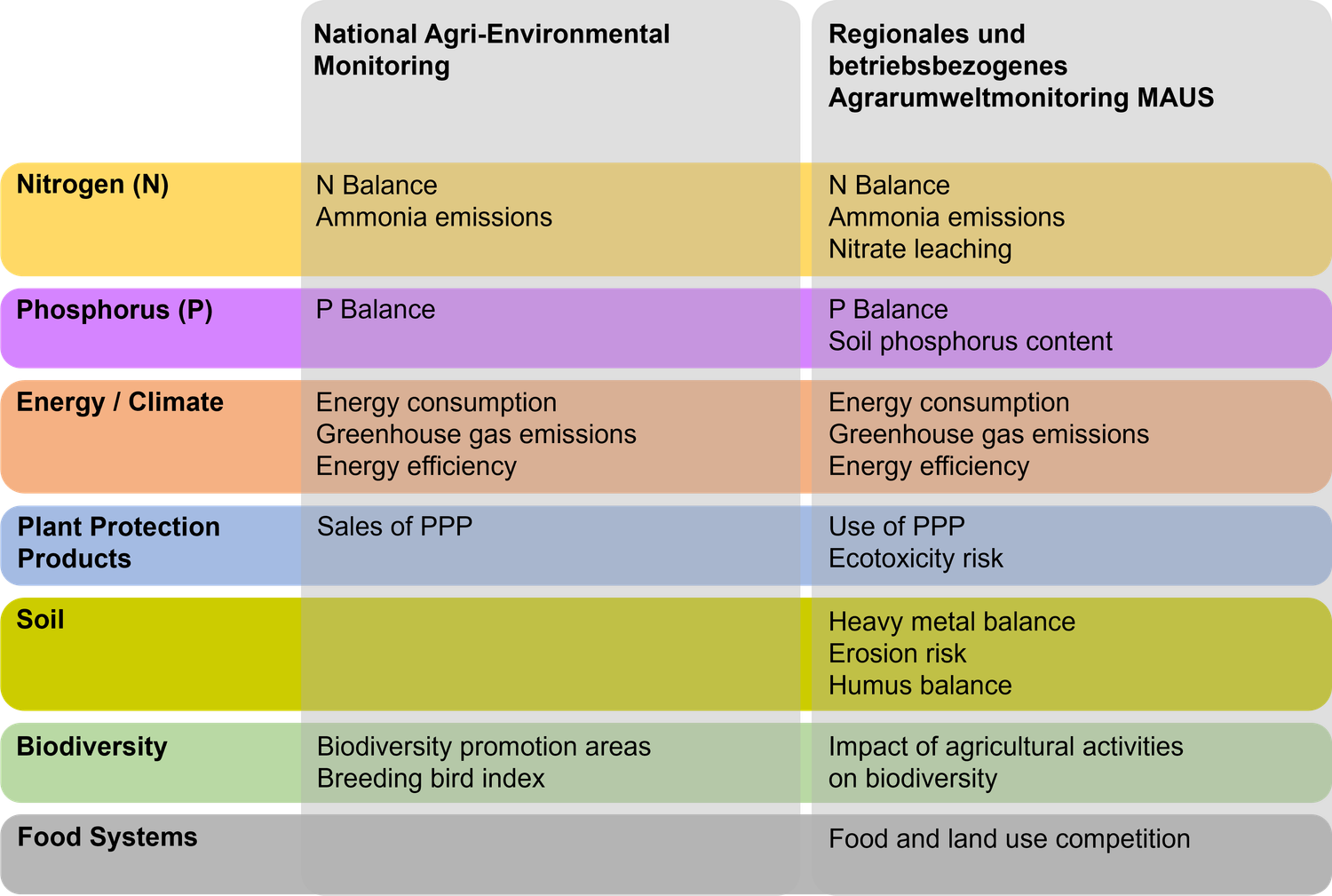
Agri-environmental monitoring primarily provides information on relevant environmental factors from agriculture that have an impact on the state of the environment. The FOEN collects data, indicators and maps from other sectors regarding the state of the environment and environmental pollution. The National Groundwater Monitoring (NAQUA), the National Surface Water Quality Monitoring Programme (NAWA) and the National Air Pollution Monitoring Network (NABEL) are particularly important in this respect. The FOEN and FOAG work together on monitoring soil and biodiversity. Their joint initiatives include the Agricultural Species and Habitats Monitoring Programme (ALL-EMA) and the National Soil Monitoring Programme (NABO)
National agri-environmental monitoring
There are time series dating back to 1990 for most of the indicators used in national agri-environmental monitoring. Agroscope calculates the majority of the national indicators.
Regional and farm-specific agri-environmental monitoring
From 2009 to 2022, the Swiss Agri-Environmental Data Network (SAEDN) coordinated data for regional and farm-specific agri-environmental monitoring. Around 300 farms collected extensive data for this purpose. The Swiss Agri-environmental Monitoring System (MAUS) replaced the SAEDN in 2023 and will provide the relevant data going forward. MAUS utilises available data as far as possible, including data from the AGIS agricultural policy information system and HODUFLU programme for recording farmyard manure flows. It also collects any missing information that is required for calculating the indicators. Agroscope works closely with the FOAG to carry out regional and farm-specific agri-environmental monitoring. They also receive support from the SAEDN agricultural monitoring support group and MAUS.
Further information
The FOAG provides a reduced English-language version of its website that does not include all further information such as documents, legislation or links. These can be found on the pages in the three official languages (German, French and Italian).