
eCH standards of the AgriFood specialist group
DigiAgriFoodCH is advancing digitalisation in the Swiss agri-food sector by creating a shared data space with agridata.ch. eCH standards enable people, organisations and IT systems to exchange data in a standardised and efficient way.This streamlines administrative processes and significantly reduces the workload for everyone involved.
The eCH Association and AgriFood
The eCH Association promotes, develops and adopts standards in the field of eGovernment, enabling efficient electronic collaboration between public authorities, businesses and private individuals.
The eCH AgriFood specialist group develops and maintains data standards across the entire value chain – from field to fork – for the Swiss agri-food sector. It was founded in 2022 as the Fachgruppe Agrardaten (Agricultural Data Group).
The eCH AgriFood specialist group is led and supported by the FOAG's Data Space and Data Management department (FOAG-DSDM).
eCH standards – a common basis for data exchange
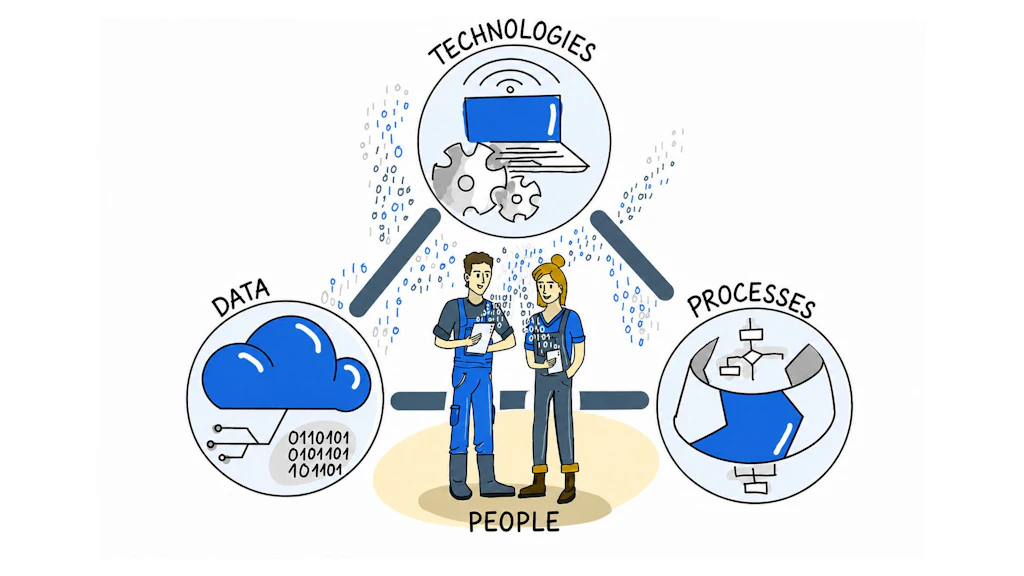
Data standard provide a common basis for data exchange within the Swiss agri-food sector. They ensure that data is described using a uniform format (data standards), that systems communicate seamlessly (interface standards) and that processes are coordinated (process standards). This facilitates collaboration between the federal government, cantons, communes, businesses, and software providers – even across organisational boundaries.
Data standards
A data standard defines how data is structured and how the different elements relate to one another. The purpose of data standards is to enable different systems to exchange and share data easily. Data structured in a uniform way improves mutual understanding between systems.
Examples
- The Minimum Geodata Model (MGDM) for agricultural land standardises the geometric mapping of agricultural areas, establishing the base data used to administer and calculate direct agricultural payments to farmers in Switzerland.
Interface standards
An interface standard defines how data is exchanged between different parties in technical terms. It is based on a shared data model that specifies which information is transferred and in what format.
Data standards therefore describe the ‘what’ of the data, while interface standards govern the ‘how’ of communication. These include transmission protocols, API interaction models such as REST, GraphQL and SOAP, data serialisation, security mechanisms and error handling.
Examples
- The eCH-0194 eUmzug Interface Standard describes how a relocation platform submits requests to a register of residents or a cantonal population register.
- The ISO 20022 Standard regulates international electronic payments.
Process standards
A process standard describes how processes should be carried out to ensure that the results are comparable, objective and transparent for all parties involved.
Examples
- Suisse Bilanz is the standardised method used throughout Switzerland to calculate the nutrient balance on farms. It ensures that all farms calculate this value according to exactly the same rules, which is a prerequisite in order to obtain the Ecological Performance Certificate (EPR).
Further information
Index
Contact for questions
Data Space and Data Management
Schwarzenburgstrasse 165
Switzerland - 3003 Bern