International organisations, partnerships and instruments
The food system transformation affects everyone and requires well-coordinated international action. The Federal Office for Agriculture (FOAG) is involved with numerous organisations to help food systems transition towards greater sustainability. This page provides more information about the key international organisations, partnerships and instruments we are involved in.
The Federal Office for Agriculture (FOAG) is involved in various organisations within the United Nations (UN), the World Trade Organization (WTO) and the Organisation for Economic Co-operation and Development (OECD).
The Committee on World Food Security (CFS) is an intergovernmental body that works to improve world food security and nutrition for all. Switzerland is a member of the CFS through two federal offices – the FOAG and the Swiss Agency for Development and Cooperation (SDC). Switzerland’s commitments include helping to finance the High Level Panel of Experts on Food Security and Nutrition (HLPE-FSN), a group of experts who compile detailed analyses and recommendations for the CFS. Several political recommendations relating to nutrition and agriculture are negotiated every year, and the FOAG is actively involved.
FAO plays a key role in global coordination, technical support and networking for research on food security, the food system transformation and sustainable use and management of natural resources. Switzerland has been a member of FAO since 1946 and sits on several FAO committees (e.g. the Committee on Agriculture, the Sub-Committee on Livestock and the Commission on Genetic Resources for Food and Agriculture).
The Organisation for Economic Co-operation and Development (OECD) is committed to creating better policies for better lives. The OECD works closely with stakeholders along the entire value chain, helping countries to share knowledge, experience and best practices by providing a wide range of advisory documents, analyses, tools and data. Its goal is to make agriculture more productive, sustainable and resilient.
In Switzerland, the State Secretariat for Economic Affairs (SECO) is responsible for cooperating with the OECD. The FOAG represents Switzerland within the Committee for Agriculture (COAG) and its working groups (Working Party on Agricultural Policy and Markets, Joint Working Party on Agriculture and Trade, Joint Working Party on Agriculture and the Environment), as well as in technical groups (Seed Schemes, the Network on Illegal Trade of Pesticides and the Food-Chain Analysis Network). The FOAG also represents Switzerland within the Working Party on Rural Policy.
Two indicatory reports are published annually:
Agricultural Policy Monitoring and Evaluation documents and analyses developments in agricultural policy and provides up-to-date assessments of agricultural support (support for producers and consumers) and environmental performance within the agricultural sector.
OECD-FAO Agricultural Outlook presents medium-term market forecasts for regional, national and international agricultural products.
For further information on the latest OECD publications relating to agriculture and food, visit the OECD iLibrary.
The WTO is an international organisation that regulates and monitors cross-border trade between its members and mediates in trade disputes. It is based in Geneva and was founded in 1995 after seven years of negotiations known as the Uruguay Round. The WTO is the institutional framework for the General Agreement on Tariffs and Trade (GATT), which was created in 1948. In addition to GATT, further agreements on other areas of international trade have been integrated into the WTO, including the Agreement on Agriculture.
The organisation currently consists of 166 member states, which together account for around 98 per cent of world trade. Switzerland has been a member of the WTO since 1995.
Partnerships
The transition towards sustainable food systems requires everyone’s involvement. It is not just an issue for governments, but for society as a whole. Multi-stakeholder partnerships are therefore an important counterpart to international organisations. These partnerships comprise states and representatives from the research community, civil society and the private sector. Stakeholder diversity is also the focus of the extra-parliamentary commission, which supports our work on food system transformation at international level by providing its own input.
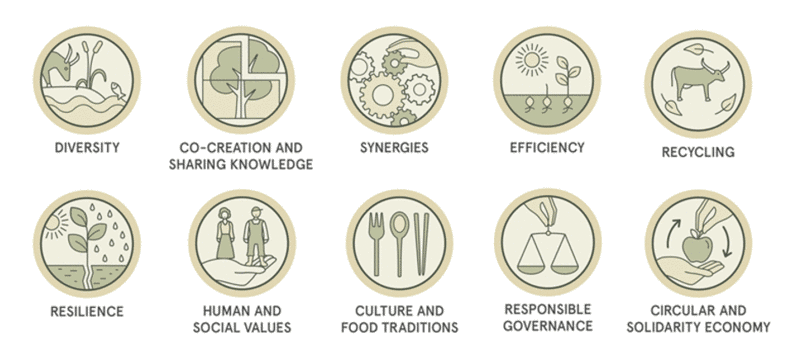
Switzerland joined the Agroecology Coalition at the 2021 World Food Summit. Today, the coalition comprises more than 50 countries and 220 organisations, including the EU, the African Union, the FAO and a large number of partner countries with which Switzerland cooperates on development policy. Members commit to promoting agricultural and food systems transformation through agroecology and the coalition’s 13 principles. The members share information and learn together how agroecology works best in practice and how successful approaches can be scaled up.
The coalition organises events and dialogue at national and international level, promoting better understanding and visibility of agroecology. Membership of the Agroecology Coalition enables Switzerland to work more intensively on national and international agroecology issues across different departments and to incorporate these issues into agricultural policy.
The Global Agenda for Sustainable Livestock (GASL) was created in 2011. At that time, there was no global framework for discussing how to make the livestock sector more sustainable. GASL is a multi-stakeholder partnership and an established platform for facilitating dialogue between different stakeholders with different approaches. The focus is on sharing strategies and best practices to promote sustainability in the livestock sector. Switzerland has been a member of the GASL since it was launched.
The Sustainable Food Systems (SFS) Programme is a global multi-stakeholder partnership that aims to accelerate the transition to more sustainable consumption and production models along the entire food value chain. Switzerland is a founding member of this initiative, and the FOAG has been a co-leader since October 2015. The SFS Programme is part of the United Nations’ One Planet Network, a mechanism for implementing the Sustainable Development Goals (SDGs) in relation to sustainable consumption and production.
The SFS Programme has played an important role in creating a shared approach to food systems. At international level, it helps to implement this approach by raising awareness of the need for greater policy coherence and participatory forms of governance; at national level, it does so by providing a range of policy instruments. The SFS Programme also supports the follow-up process to the UN’s 2021 Food Systems Summit, in particular through its Working Group to Support the Implementation of National Pathways for Food Systems Transformation. Approximately every two years, the SFS Programme organises Global Conferences in the run-up to international processes on issues such as nutrition, climate and biodiversity.
The Global Framework on Water Scarcity in Agriculture (WASAG) was established in 2016 at the UNFCCC Climate Change Conference in Marrakesh, Morocco. WASAG was developed to bring together key stakeholders from around the world and from different sectors to address the shared challenge of improving water use in agriculture and ensuring food security for all.
WASAG is a multi-stakeholder partnership whose secretariat is based at FAO. The partnership comprises government agencies, international organisations, research institutions, special interest groups and professional/member organisations. WASAG encourages its partners to cooperate on developing and implementing policies, strategies and programmes to improve local capacity for adapting agriculture to water scarcity. Switzerland has supported WASAG since 2019 and joined the partnership’s new Steering Committee in October 2024.
Instruments
A range of international thematic instruments are relevant to the agriculture and agri-food industry. Below you will find the key global instruments in which the FOAG is actively involved.
The International Plant Protection Convention (IPPC) is an intergovernmental treaty signed by more than 180 countries. It aims to protect the world’s plant resources against the spread and importation of pests and to promote safe trade. The convention has adopted International Standards for Phytosanitary Measures (ISPM) as the main instrument for achieving its objectives, making it the only global organisation that sets standards for plant protection.
Further information about plant health in Switzerland is available on this page.
The International Treaty on Plant Genetic Resources for Food and Agriculture (ITPGRFA) is an important instrument for promoting the diversity of plants used in agriculture. This diversity is crucial to tackling global challenges relating to soil fertility loss, biodiversity loss and climate change. As these challenges intensify, agriculture and plant cultivation are increasingly dependent on crop diversity.
The International Union for the Protection of New Varieties of Plants (UPOV) is an intergovernmental organisation based in Geneva. It was established by the International Convention for the Protection of New Varieties of Plants, which was adopted in Paris in 1961 and revised in 1972, 1978 and 1991. UPOV’s mission is to provide an effective system of plant variety protection, with the aim of encouraging the development of new plant varieties for society’s benefit.
Further information about the protection of different varieties in Switzerland can be found on this page.
Further information
The FOAG provides a reduced English-language version of its website that does not include all further information such as documents, legislation or links. These can be found on the pages in the three official languages (German, French and Italian).