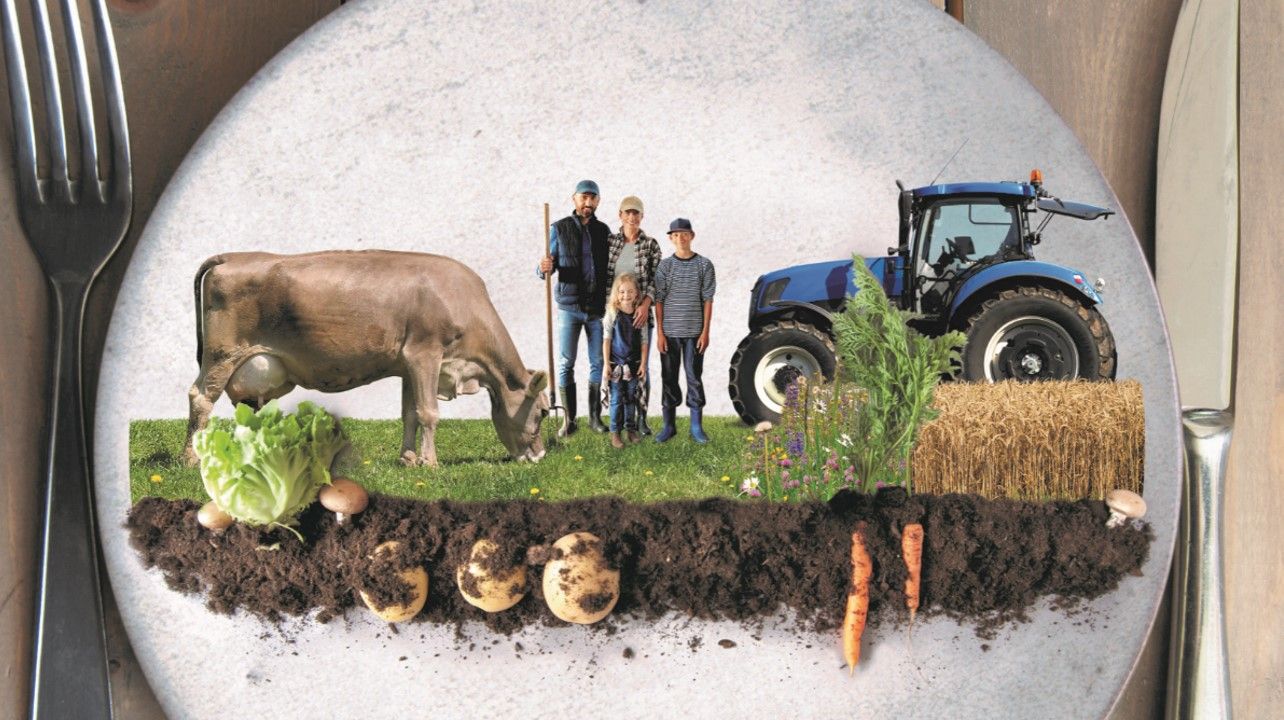
The Federal Council approved the report on the future direction of agricultural policy in June 2022. The report explains how the Swiss agricultural and agri-food sectors can make an even greater contribution to food security in the future. It analyses the food system as a whole, from production to consumption. The proposed strategy will be applied in three stages.
The Federal Council involves all stakeholders within the food system in its food security strategy, including farmers, intermediaries, processing companies and consumers. Based on the constitutional provisions on agriculture and food security, the Federal Council has set the following goal for 2050:
To ensure food security from farm to table thanks to sustainable development.
The Federal Council’s projection shows how the Swiss agricultural and agri-food sectors can achieve this goal by 2050. Domestic production also plays a key role.
According to the projection, agriculture will still have to produce more than half of the food required in 2050.
The aim is to increase labour productivity by 50% compared with 2020 and reduce greenhouse gas emissions by 40% compared with 1990. However, processing companies and consumers must also play their part.
Compared to today’s amounts, food waste throughout the value chain will need to be reduced by three quarters, and greenhouse gas emissions from food consumption will need to be cut by two thirds.
Frequently asked questions
Domestic production must continue to account for at least the same proportion of Switzerland’s food supply as now.
By better preserving natural resources and ensuring production remains within ecosystems’ carrying capacity in future, food security will be strengthened overall compared to the present day.
Measures to reduce the loss of fertilising elements and use of plant protection products (PPPs) or to increase areas devoted to biodiversity on arable land may limit food production in the short term, which could lead to a decline in our self-sufficiency rate if dietary habits remain the same.
This conflict can be mitigated by using resources more efficiently, e.g. through widespread application of production systems that use fertilising elements more efficiently and further advances in plant and animal breeding.
Environmental targets promote food security in the medium and long term, because taking account of ecological carrying capacity helps to preserve production bases (such as soil fertility, biodiversity, drinking water and water availability) for future generations.
In principle, national environmental targets could be reached without changing our approach to food.
However, this would mean that the ecological footprint of food would remain high, with no reduction in health risks.
If we modified our production without changing our consumption, this would lead to a rise in imports, which would transfer the environmental impact to other countries and have a detrimental effect on global food security.
Good social (and economic) prospects in agriculture and good social welfare for farming families are important factors in the projection.
They are vital to ensuring that the profession remains attractive and that agriculture can make a significant contribution to long-term food security.
AP22+ marks an important step forward, with better social protection for spouses working on farms.
Further information
The FOAG provides a reduced English-language version of its website that does not include all further information such as documents, legislation or links. These can be found on the pages in the three official languages (German, French and Italian).