
Swiss Federal Plant Protection Service (SPPS)
The Swiss Federal Plant Protection Service (SPPS) aims to prevent the introduction and spread of plant diseases and pests, thereby protecting agriculture and the environment. The SPPS is managed by the Federal Office for Agriculture (FOAG) and the Federal Office for the Environment (FOEN). This web page provides information about the SPPS's activities and organisation, and the latest updates on plant health.
Plant health: Protection against pests and diseases
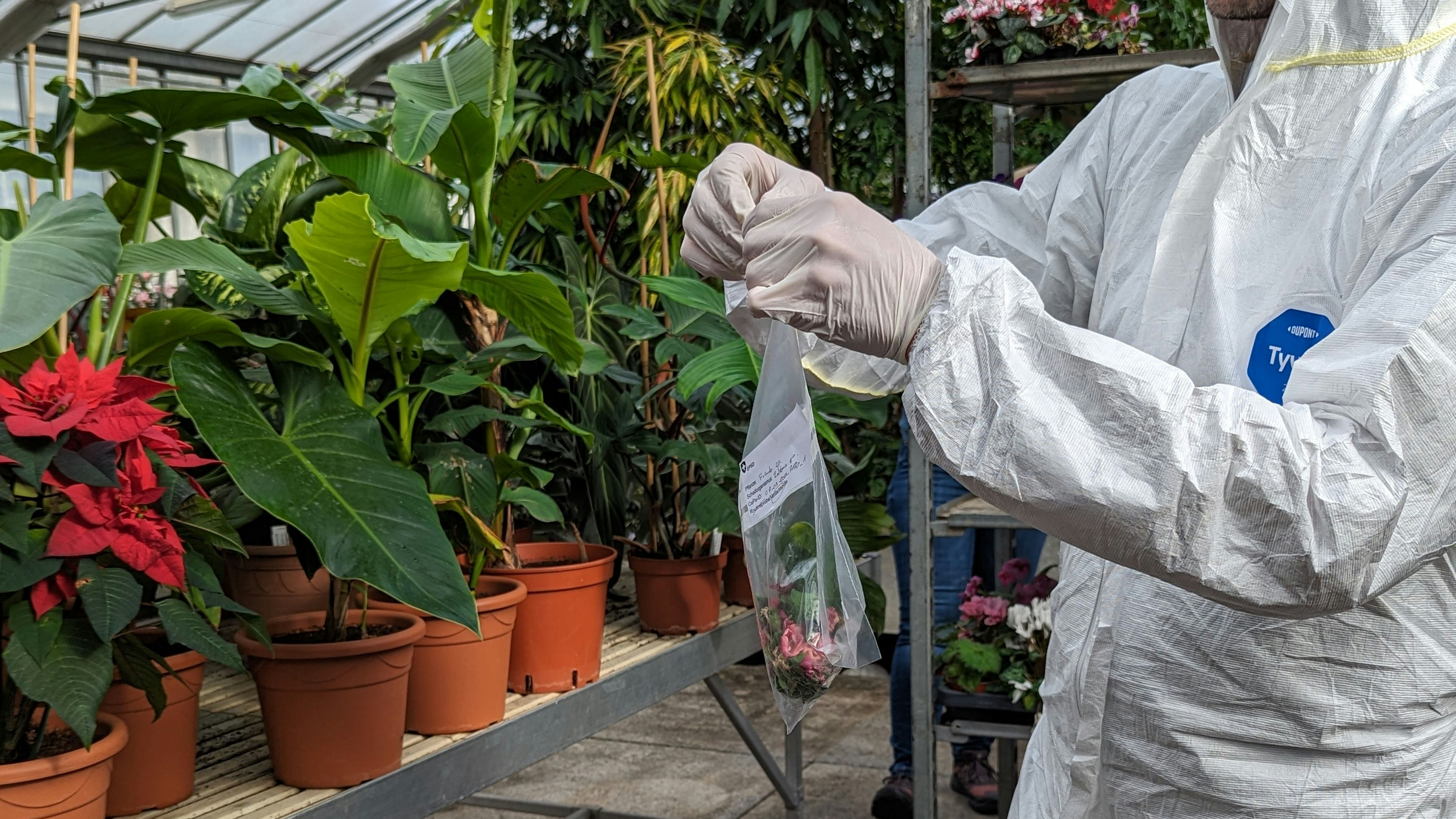
Plant diseases and pests can cause serious damage – to crops, gardens, forests and the natural environment. Many of these pathogens and pests originate in other parts of the world, where they usually do not cause much trouble. But when they are introduced into new regions, for example through global trade or travel, they often lack natural predators and can spread unchecked. This can have serious economic and environmental consequences. Protecting plant health is therefore essential for agriculture, the environment, and ensuring a reliable supply of healthy plants and food.
At a national level, the Swiss Federal Plant Protection Service (SPPS) is responsible for preventing the introduction and spread of particularly dangerous pathogens and pests. This is crucial for avoiding economic, social and environmental damage. The SPPS is jointly managed by the Federal Office for Agriculture (FOAG) and the Federal Office for the Environment (FOEN).
Activities
The SPPS is particularly active in the following areas:
Import checks
Conducting import checks at Geneva and Zurich airports to examine the health of plant products.
Business registration and approvals
Registering businesses involved in the production or trade of certain plant products (e.g. nurseries, seed producers, garden centres, manufacturers of wood packaging material). The SPPS also issues business approvals in accordance with plant health legislation (plant passports, ISPM 15 marking).
Authorisation requirements and obligations of approved businesses
Verifying the approval requirements and obligations for approved businesses through annual administrative and phytosanitary inspections. Some of these inspections are carried out on behalf of the SPPS by external inspection bodies (Veriplant AG, Swisssem / propagation organisations, and SKSH AG).
Territory surveillance
Annual surveillance activities are carried out in collaboration with cantonal plant protection services and forest protection officers. The aim is to detect quarantine organisms at an early stage.
Eradication or containment of quarantine organisms
When a quarantine organism is detected in Switzerland, the SPPS defines the measures required to eradicate or contain it. To facilitate this, the SPPS prepares corresponding emergency plans. If an infestation is found in an approved business, the SPPS is responsible for implementing or arranging control measures. Responsibility for infestations outside approved businesses lies with the cantonal authorities.
Plant health legislation
Developing Switzerland’s plant health legislation based on the situation in Europe and in line with EU law. Coordinating the enforcement of this legislation at national level. Developing strategies for monitoring and controlling regulated pathogens and pests, in collaboration with Agroscope, the Swiss Federal Institute for Forest, Snow and Landscape Research (WSL), the cantonal authorities, and national and international organisations and associations.
International exchange
Maintaining contact with the European Commission, the national plant protection organisations of the EU member states, the European and Mediterranean Plant Protection Organisation (EPPO), and the IPPC Secretariat. As Switzerland and the EU share a common plant health area, and significant trade takes place with non-EU countries, strong international collaboration in plant health is essential.
Information and awareness-raising
Communicating in a targeted way with the public and the green sector about emerging threats and new regulations. The SPPS also informs the cantonal authorities and professional associations of the presence of quarantine organisms, provides relevant information, and delivers training to specialists.
Organisation and structure
FOAG and FOEN
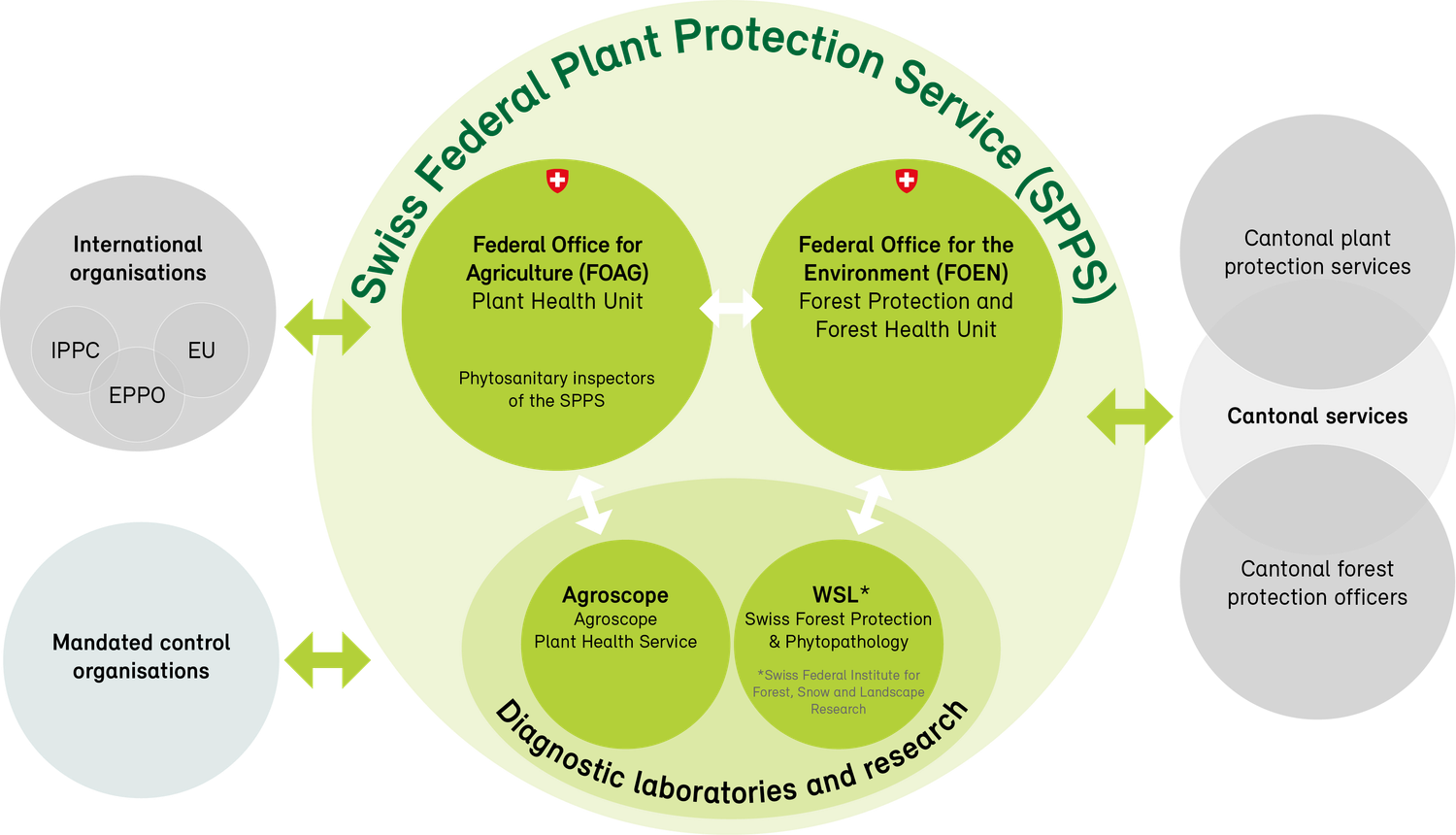
The SPPS is jointly run by the Federal Office for Agriculture (FOAG) and the Federal Office for the Environment (FOEN).
Agroscope and WSL
Agroscope is responsible for the scientific and technical aspects of plant health in the agricultural and commercial horticultural sector, while the Swiss Federal Institute for Forest, Snow and Landscape Research (WSL) is responsible for forestry matters.
Both research institutions carry out risk analyses, develop control strategies and are also involved in monitoring and import controls for quarantine organisms and other new harmful organisms.
The Agroscope and WSL laboratories are the official laboratories of the Swiss Federal Plant Protection Service (SPPS) and are known as the ‘SPPS diagnostic laboratories’. They carry out phytosanitary enforcement diagnostics on behalf of the FOAG and FOEN, which are both part of the SPPS. The National Reference Laboratories (NRL), located at Agroscope, act as the interface with the EU Reference Laboratories in the fields of bacteriology, entomology, mycology, nematology, phytoplasmology and virology.
External laboratories
In exceptional cases and under strict conditions, diagnostic services related to enforcement may be outsourced to external laboratories. Outsourcing requires a formal request in each case. To obtain the application form, please email phyto@blw.admin.ch.
Cantonal offices
The cantonal plant protection services (CPPS) and forest protection officers also make an important contribution to the protection of plant health in Switzerland. They are primarily responsible for conducting the annual territory surveillance of designated quarantine organisms and for taking or ordering control measures in the event of an outbreak in their region – unless an approved business is affected, in which case the SPPS is responsible.
Plant health legislation
A new phytosanitary law has been in force in Switzerland since 1 January 2020. Stricter regulations and a strengthening of preventive measures will increase the protection of plants against particularly dangerous pathogens and pests.
Further information
The FOAG provides a reduced English-language version of its website that does not include all further information such as documents, legislation or links. These can be found on the pages in the three official languages (German, French and Italian).
Index
Related topics
Contact for questions
Swiss Federal Plant Protection Service SPPS
Schwarzenburgstrasse 165
Switzerland - 3003 Bern