
Statistics and analyses
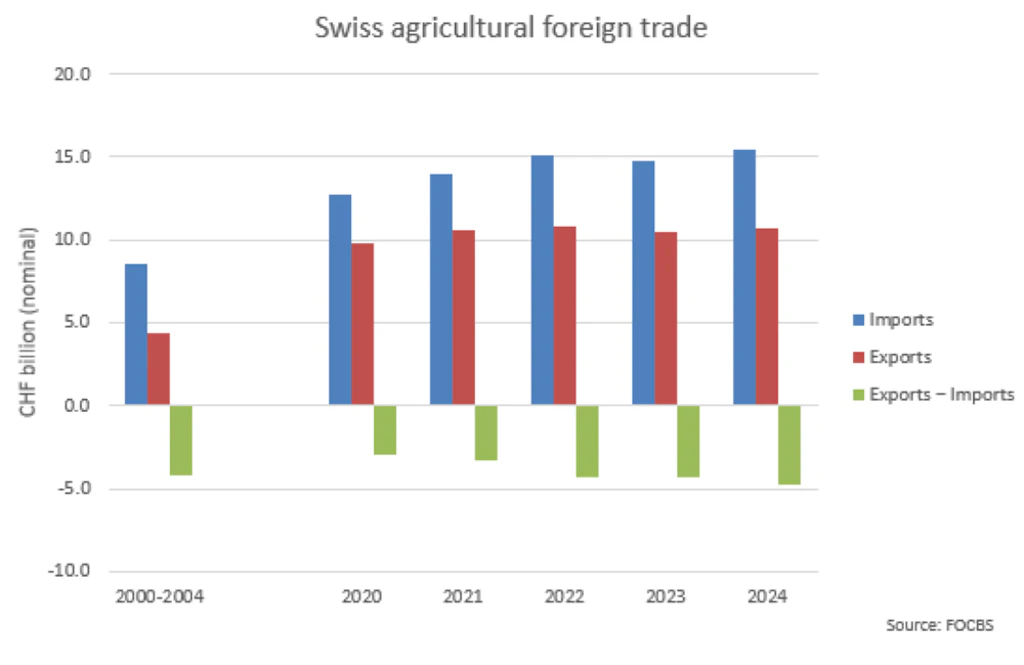
Swiss foreign agricultural trade (imports and exports) reached a record high in 2024, with agricultural exports rising to CHF 10.7 billion, or 4% of total exports. In the same year, Switzerland imported CHF 15.5 billion worth of agricultural products, or 7% of its total imports. The trade deficit of CHF 4.8 billion grew by 11% compared to 2023, hitting a record high, as import growth exceeded export growth.

Foreign agricultural trade
The agricultural tariff lines correspond to those agreed with the World Trade Organization (WTO). They also include all chapters of the Harmonized Commodity Description and Coding System (World Customs Organization) from Chapter 25 onwards, which cover both agricultural and industrial products. Only agricultural products have been taken into account.
Foreign trade at a high level
In 2024, both exports and imports increased. Agricultural exports amounted to CHF 10.68 billion, or CHF 4.8 billion less than imports (CHF 15.47 billion). Imports reached an all-time high. The agricultural trade balance fell by 10.8% in 2024 compared with 2023, reaching a record low. This was due to a 4.4% increase in imports, which exceeded the 1.8% increase in exports.
The increase in exports (+CHF 192 million) in 2024 compared with the previous year was due in particular to coffee (+CHF 186 million) and chocolate (+CHF 138 million). These increases exceeded the decline in exports observed for cereal-based food products (−CHF 86 million) and beverages (−CHF 83 million).
Imports increased three times more than exports (+CHF 659 million); the rise was particularly marked in the case of cocoa (+CHF 337 million) and coffee (+CHF 120 million). Detailed data can be found in the Swiss foreign trade statistics. Cross-border shopping tourism is not included in the figures.
Two thirds of Switzerland’s foreign trade is with the EU
The EU27 is still Switzerland’s main agricultural trading partner. In 2024, 73% of all imports were from the EU, while 51% of all exports were to the EU. Overall trade (imports and exports) with the EU accounted for 64% of Switzerland’s total trade.
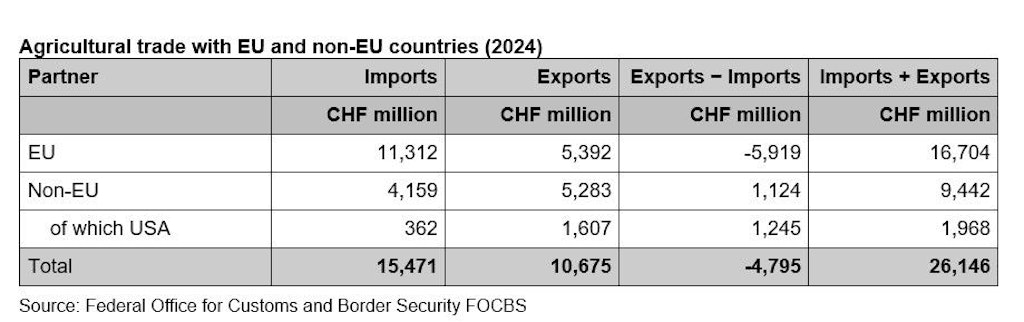
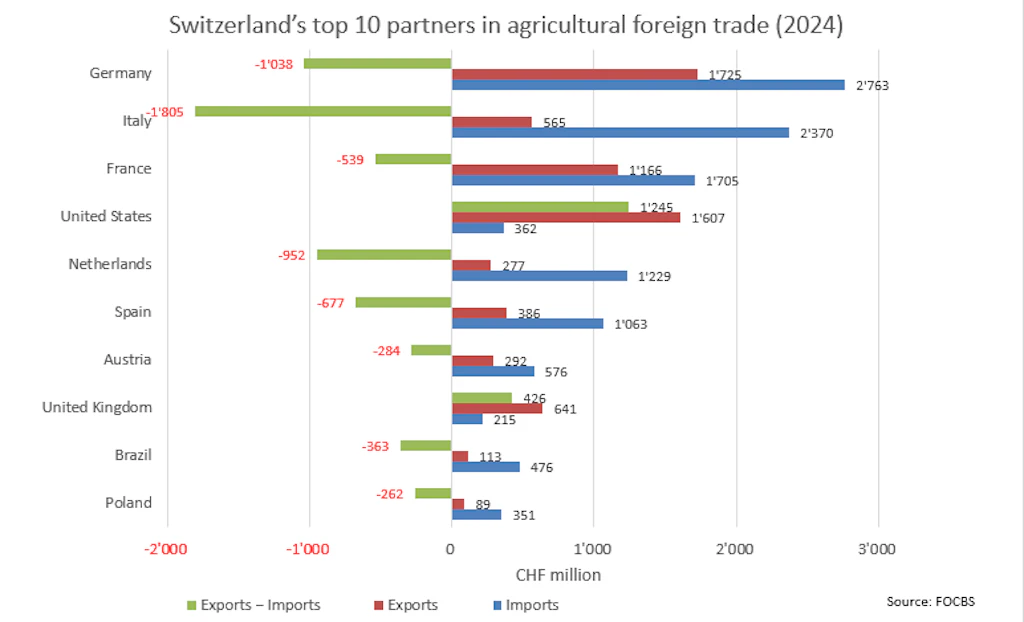
Imports of bottled red wine from the EU were particularly high in 2024 (CHF 617 million). On the export side, trade in roasted coffee was especially strong (CHF 1.3 billion). Germany, France and Italy alone account for 62% of trade with the EU, and Switzerland’s agricultural trade balance with these countries is negative (as it is with the EU as a whole). Trade balances with the United States, the United Kingdom and Canada are positive, at CHF 1.245 billion, CHF 426 million and CHF 342 million respectively. In 2024, the trade surplus with the United States was higher than the surplus for all non-EU countries combined. This was due to exports to the US worth CHF 1 billion for coffee, CHF 130 million for soft drinks and CHF 112 million for cheese.
Trade balance for dairy products at a historic low
In 2024, 36% of Switzerland’s foreign agricultural trade (imports and exports) was accounted for by coffee, tobacco, plant extracts (Chapters 9, 13 and 24 of the Harmonized Commodity Description and Coding System) and beverages (Chapter 22).
The trade balance for coffee, tobacco and plant extracts (Chapters 9, 13 and 24) was particularly high, at CHF 2.1 billion. The export surplus for food preparations, including chocolate (Chapters 18 and 21), was 12 times lower by comparison (CHF 166 million). In contrast, the trade balances for fruit, vegetables and live plants (Chapters 6, 7, 8 and 20) (−CHF 3.4 billion), cereals and cereal products (Chapters 10, 11, 19) (−CHF 821 million) and meat and meat products (Chapters 2 and 16) (−CHF 783 million) were particularly negative.
In 2024 the trade balance for dairy products, eggs and honey (Chapter 4) was negative for the second time in at least 35 years – the first time having been in 2023. In 2024 it stood at −CHF 20 million. This was largely due to the 2024 trade balance for dairy products, which was positive but low (CHF 130 million). This is just 41% of the 1990–1992 level (CHF 319 million).

Processing trade
Processing is an essential part of Switzerland’s foreign agricultural trade.
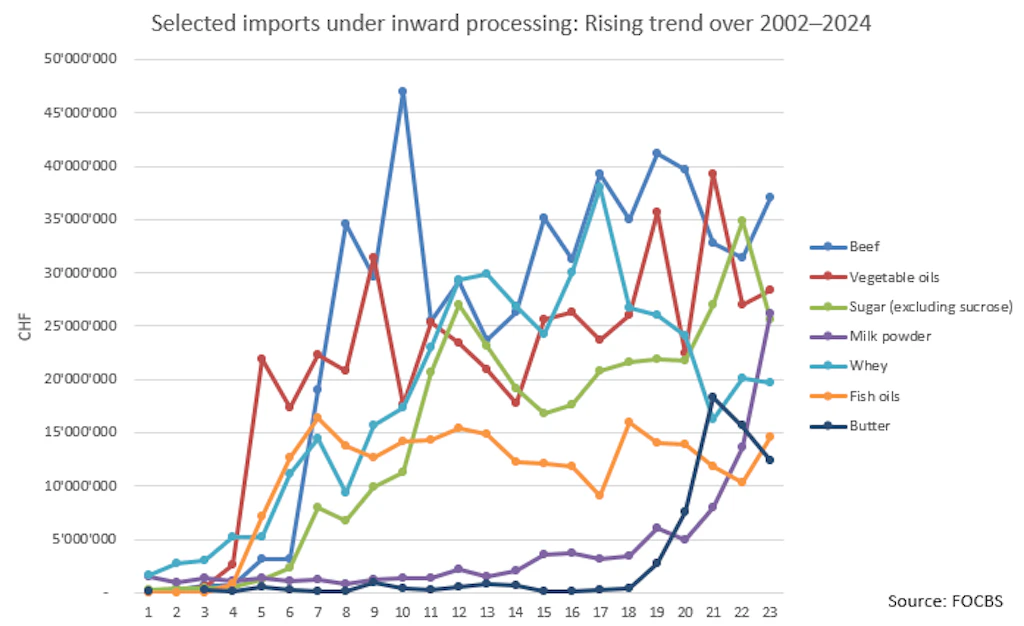
Inward processing involves temporarily importing foreign goods for processing or treatment in Switzerland and subsequently re-exporting them. In 2024, Switzerland imported agricultural products worth CHF 251 million under regular inward processing. This equated to 2% of total Swiss agricultural imports (CHF 15.5 billion), and 60% more than in 2002. The main products were sugar (excluding sucrose), boneless beef for the production of Bündnerfleisch, vegetable fats and oils, whey, butter and other milk fats, and milk powder (imports of which are experiencing strong growth). In the same year, Switzerland re-exported processed agricultural products worth CHF 1.9 billion under inward processing. This equated to 18% of its total agricultural exports (CHF 10.7 billion), and 67% more than in 2002. The main products were soft drinks, infant food preparations, chocolate, cigarettes, other food preparations, filled pasta, odoriferous substances and dried beef. In addition to these figures for inward processing carried out under the regular procedure, there is also a special procedure.
Outward processing involves processing or treating goods of domestic origin outside Switzerland and then re-importing them. These goods flows are less significant than those under inward processing. In 2024, CHF 35 million of the agricultural exports from Switzerland were handled under outward processing. This equated to 0.3% of Switzerland’s total agricultural exports, and 90% more than in 2002. The main products were wheat flour, condensed dairy cream, potatoes, poultry and pork. In the same year, re-imports under outward processing amounted to CHF 71 million, or 0.5% of Switzerland’s total agricultural imports – a rise of 184% compared to 2002. Bakery products, potatoes in the form of crisps or chips, poultry and pork products and dairy cream were the principal goods reimported.
Average customs tariff of 4.9% on agricultural products
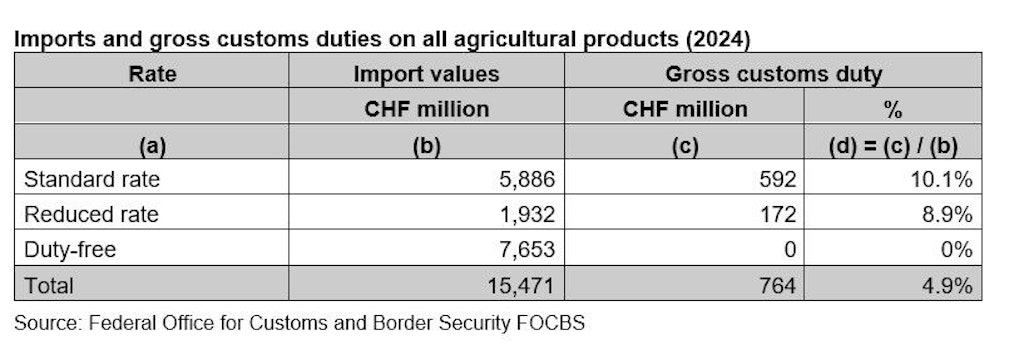
IIn 2024, 49% of Swiss agricultural imports were duty-free, primarily based on preferential tariffs with the EU, zero tariffs with all members of the World Trade Organization (WTO) or customs facilitations for special usages of imported goods. Customs tariff exemptions were also granted under free trade agreements with third countries, for the benefit of developing countries and for processing trade. The weighted average gross customs tariff for all imported agricultural products amounted to 4.9% of the import value. This relatively low average tariff was due to the fact that goods can also be imported at the in-quota tariff, which by definition is lower than the out-of-quota tariff.
Frequently asked questions
Further information
The FOAG provides a reduced English-language version of its website that does not include all further information such as documents, legislation or links. These can be found on the pages in the three official languages (German, French and Italian).