
Agriculture as a central element of the WTO
The World Trade Organization (WTO) regulates cross-border trade between countries and provides the legal framework for the multilateral trading system. As the basis for feeding the global population, agriculture occupies a special position in world trade. Due to this important role, a specific agreement was negotiated: the WTO Agreement on Agriculture.
How the WTO works
The goal of trade regulation
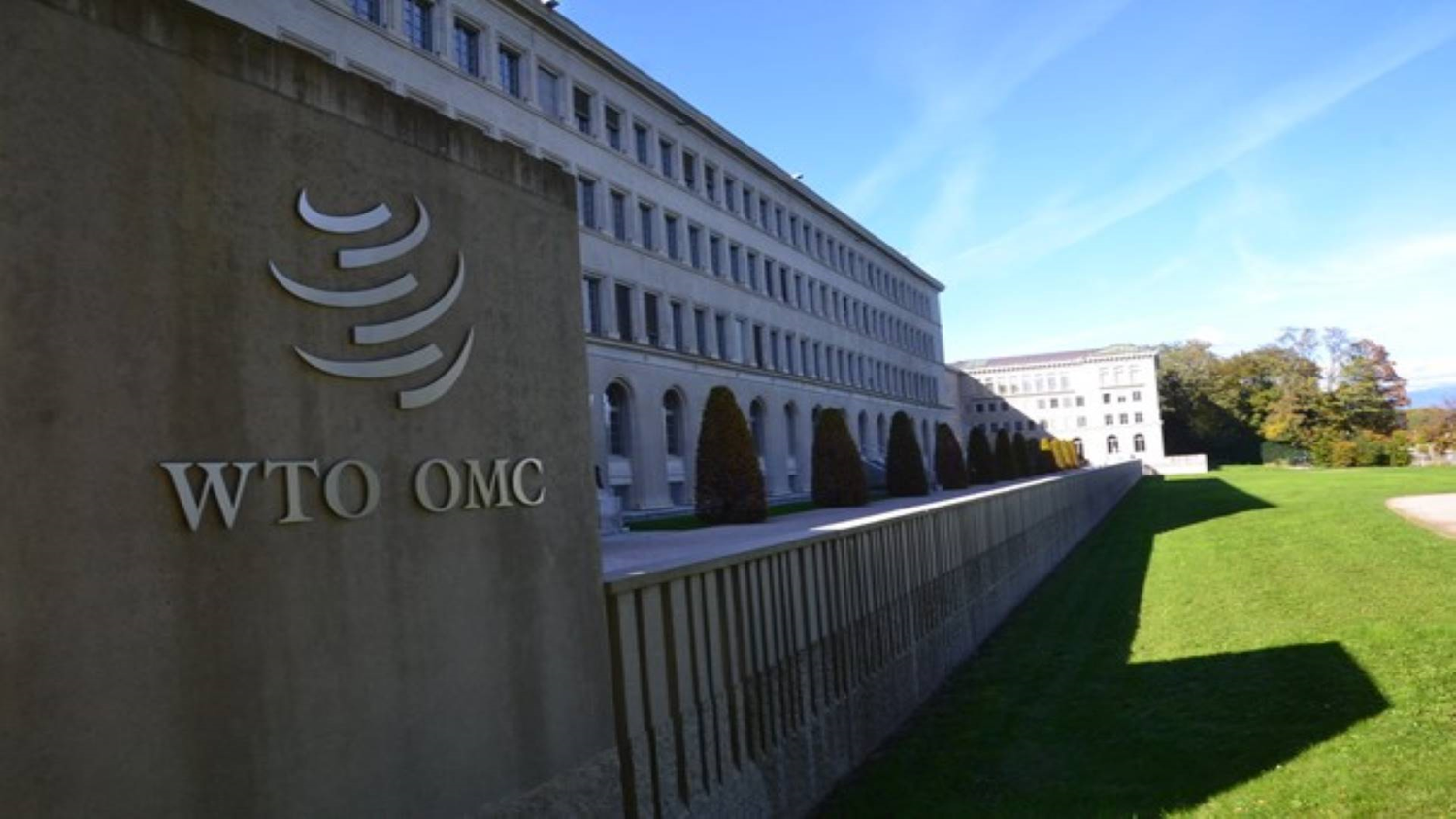
The WTO’s overarching goal is to regulate and monitor cross-border trade relations between its members and to mediate in trade disputes. This international organisation is based in Geneva and was established in 1995 following seven years of negotiations known as the Uruguay Round. It is the institutional framework for the General Agreement on Tariffs and Trade (GATT), which was created in 1948. In addition to GATT, further agreements on other areas of international trade have been integrated into the WTO, including the Agreement on Agriculture. The organisation currently consists of 166 member countries, which together account for around 98% of world trade.
The main features of the WTO
The WTO offers its members a forum to discuss their trade concerns, share knowledge and work together to develop existing multilateral rules. The aim is to prevent trade disputes through transparency and dialogue. The main features of the WTO can be summarised as follows:
- It creates and maintains a system of rules for international trade, which ensures greater transparency and predictability.
- It removes barriers to trade.
- It has a mechanism for settling disputes in trade matters.
A range of committees for different issues
The WTO runs a range of committees and working groups that deal with the different issues covered by WTO rules. The Committee on Agriculture, for example, is responsible for implementing the Agreement on Agriculture. Within this committee, members must disclose their agricultural policy measures. However, other committees may also engage with issues relevant to agriculture, including geographical information and plant and animal health measures.
A ministerial conference every two years
In order to negotiate changes to existing rules, member countries meet for negotiation rounds based on a mandate established by ministers. Ministerial conferences are held every two years. As the highest decision-making body, the conference’s aim is to agree on new rules for world trade. Member countries can also initiate dispute settlement proceedings if they believe that an agreement has been violated by another country.
WTO Agreement on Agriculture
An agreement for agriculture
Between the introduction of GATT in 1948 and the creation of the WTO in 1995, there were no uniform regulations for international trade in agricultural commodities. This resulted in massive agricultural market intervention by industrial countries and, in turn, to overproduction. These countries sold the excess products on the world markets at subsidised prices, distorting international trade. In this context, an agreement setting out binding rules for agricultural support by member countries became increasingly important. Ultimately, this gave rise to the WTO Agreement on Agriculture, which was integrated into the WTO/GATT rules.
The WTO Agreement on Agriculture aims to reform agricultural trade in order to create more competitive market conditions and fair trade rules. It consists of general rules that apply to all WTO members and provides for a significant and gradual reduction in agricultural support and border protection.
The three pillars of the Agreement on Agriculture
The Agreement on Agriculture is based on three pillars: domestic support, market access and export competition.
The schedule of commitments sets out the rules
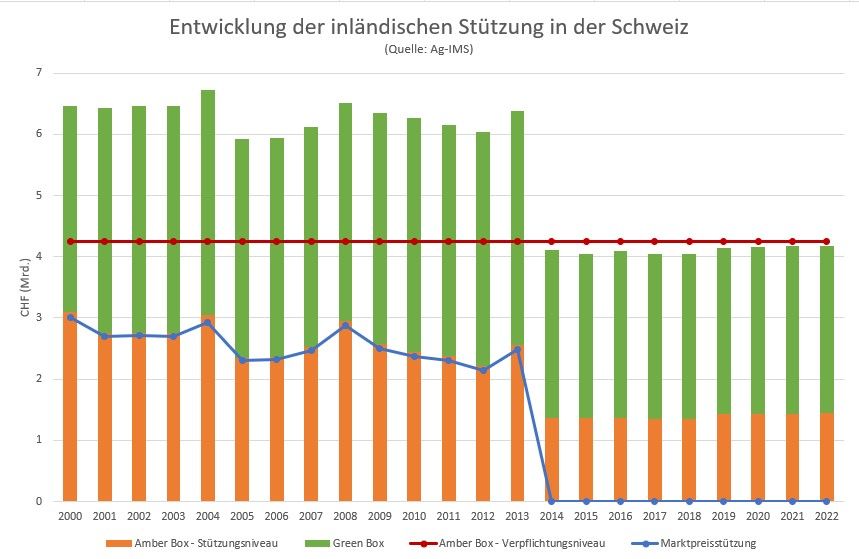
During the negotiations to establish the WTO, the members – including Switzerland – agreed to specific commitments relating to domestic support, market access and export competition. These are set out in schedules of commitments, which stipulate the maximum customs tariff countries may levy on a particular agricultural product.
The Committee on Agriculture monitors the Agreement on Agriculture
The Committee on Agriculture is responsible for monitoring the Agreement on Agriculture. This forum enables member countries to question each other on compliance with the agreement. Commitments are reviewed based on notifications that the member countries must submit on a regular basis. These notifications cover the measures taken under the three pillars. For instance, Switzerland must report the extent of its internal support measures every year.
WTO agricultural negotiations
Members negotiate agricultural reform
In 1995, the Uruguay Round ended with the establishment of the WTO and the conclusion of additional agreements such as the Agreement on Agriculture. However, this was not the end of agricultural trade reforms. The member countries agreed to work towards a new round of negotiations after a transition phase, with the aim of developing the Agreement on Agriculture. The most recent round of negotiations was launched in Doha in November 2001 (Doha Round), but has not yet been concluded due to member countries’ divided views.
Little progress on reform, but some resolutions adopted
Despite the breakdown of the Doha Round, agricultural negotiations are continuing at special meetings of the Committee on Agriculture. The goal is to draw up negotiation proposals that can then be finalised at a ministerial conference. No major reforms have resulted from the agricultural negotiations in recent years. However, some resolutions have been adopted at past ministerial conferences.
- Ninth Ministerial Conference, Bali, 2013: Ministers adopted a resolution ensuring greater transparency in tariff quota administration and providing a mechanism for systematically unused quotas.
- Tenth Ministerial Conference, Nairobi, 2015: Member countries agreed to abolish export subsidies.
- Twelfth Ministerial Conference, Geneva, 2022: Member countries resolved not to impose export bans or restrictions on deliveries to the World Food Programme.
- Thirteenth ministerial conference, Abu Dhabi, 2024: due to ongoing disagreements, no further resolutions were adopted.
Ministerial Conference MC14
The 14th WTO Ministerial Conference MC14 (March 26–29, 2026, Yaoundé) once again failed to produce any decisions on agriculture. Long-standing, irreconcilable differences in positions on this issue—particularly among major members—persist.
Twelve members, including Switzerland, reaffirmed at MC14 their commitment to continuing the dialogue on emerging agricultural trade issues (EAT). The aim of this dialogue is to achieve more sustainable agricultural trade and to find solutions to long-term challenges in the agricultural trade sector. The dialogue is open to all members and takes place independently of the WTO agricultural negotiations.
The next Ministerial Conference is scheduled for 2028, with Saudi Arabia under consideration as a potential host.
Switzerland is committed to balance
As a small country, Switzerland has an interest in preserving the WTO’s multilateral framework. It is important to Switzerland that agricultural negotiations are balanced and that no individual issues dominate. Switzerland is therefore committed to ensuring that its interests remain part of the negotiations. These include stricter rules on export competition and export restrictions.
Switzerland as group coordinator
Switzerland coordinates the G-10 negotiating group, which consists of net agricultural importers. Its other members are Iceland, Israel, Japan, Liechtenstein, Mauritius, Norway, South Korea and Taiwan. The G-10 members have similar concerns in relation to domestic support and market access. During negotiations, they lobby for non-trade factors, such as sustainability issues, to be taken into account in agriculture.
Trade Policy Reviews to maintain transparency
The entire trade policy under the microscope
The Trade Policy Review Mechanism (TPRM), under which WTO members’ national trade policies are periodically assessed, is a key tool in achieving transparency along with the notifications. Reports from the WTO Secretariat and the member concerned serve as a source of information and a basis for discussion: Interested countries can submit questions based on the reports, which must be answered in writing. The TPR procedure concludes with a hearing at the WTO, where all interested WTO members can express their views once again. In addition, the member whose trade policy is being reviewed is given the opportunity to comment on all points.
Switzerland is active in TPR proceedings
Switzerland participates heavily in the TPR processes of other countries. The reports provide a good overview of trade-relevant developments in the policies of other members. By asking questions, Switzerland also has the opportunity to obtain more information if an issue or development is of importance to Switzerland.
The last review of Swiss trade policy took place in 2022
The review of Swiss trade policy is always conducted jointly with Liechtenstein – most recently in 2022 In the agricultural sector, Switzerland had to comment on, among other things, its subsidies, tariff levels, and tariff quotas. Overall, Switzerland is perceived as a reliable partner and valued for its consistent support of the multilateral system.
Further information
The FOAG provides a reduced English-language version of its website that does not include all further information such as documents, legislation or links. These can be found on the pages in the three official languages (German, French and Italian).