
Importing plants
If you are planning on importing plants or plant products such as fruit, seeds, cut flowers or wood into Switzerland from another country, you need to observe the applicable provisions. Imports carry the risk of spreading dangerous diseases and pests.
The most important information in brief
- When importing plants and plant material, regulations apply that must be taken into account.
- If plants are imported from EU countries, a plant passport is usually required.
- If plants are imported from non-EU countries, a phytosanitary certificate is required.
- The import of certain plants from non-EU countries is completely prohibited.
- The import of soil and organic substrate from non-EU countries is prohibited. In some cases, an exemption permit can be issued.
- Fruits of pineapples, coconuts, durians, bananas and dates may be imported into Switzerland from any country without a phytosanitary certificate.
- The aim of the applicable provisions is to protect the health of our plants by preventing the introduction and spread of dangerous diseases and pests.
Importing from the EU and Liechtenstein
The bilateral Agreement on Agriculture between Switzerland and the EU ensures uniform rules for the import and export of plants and plant material within Switzerland, the EU and Liechtenstein. The plant passport governs import/export within this region.
This applies to private individuals, companies and professionals
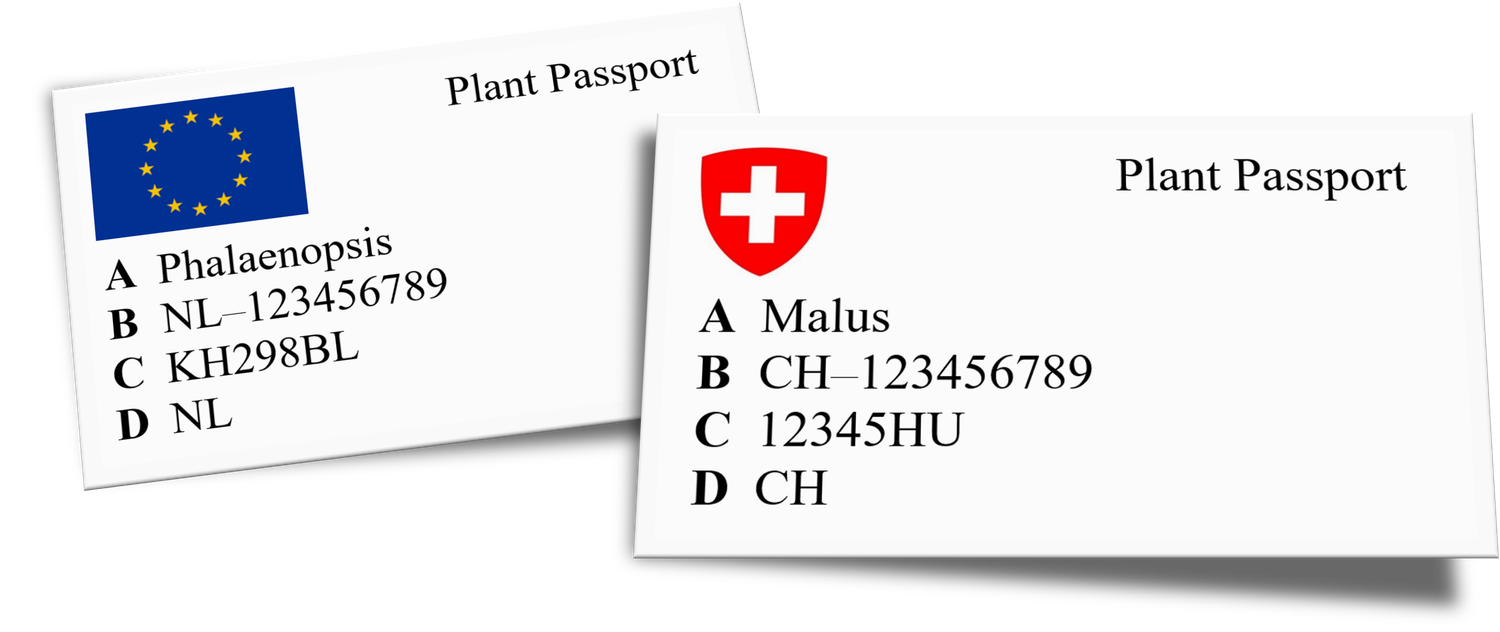
Plants that are carried in personal luggage or as household goods when moving house do not require a plant passport. A plant passport is required for goods sent by post or courier.
Fruits, vegetables and cut flowers may be imported and exported without a plant passport.
Further information on the plant passport can be found on the Plant Passport System page.
Goods requiring a plant passport
- Plants and parts of plants (other than seeds) which are intended to remain planted, to be planted or to be replanted, regardless of the botanical species – for example, pot plants, plant arrangements in bowls, seedling, cuttings, tissue cultures, bulbs, tubers, etc.
- Seed potatoes (Solanum tuberosum), pines (Pinus), Douglas fir (Pseudotsuga menziesii)
- Citrus fruits with leaves and peduncles
- Wood obtained from Juglans (walnut), Platanus (plane) and Pterocarya (wingnut)
- Plants and parts of plants not intended for planting (other than their fruits and seeds) of the following genera: Choisya (Mexican orange) and its hybrids; Citrus (citrus plants), Fortunella (kumquat), Poncirus (trifoliate orange) and their hybrids (incl. fruits with leaves and peduncles); Casimiroa, Clausena, Murraya (orange jasmine, curry tree), Vepris, Zanthoxylum and Vitis (grapevine)
Forest reproductive material
Imports of forest reproductive material, such as seeds, cuttings, etc. require a licence issued by the Federal Department for the Environment (FOEN) (webpage available in German, French and Italian).
Convention on International Trade in Endangered Species of Wild Fauna and Flora (CITES)
The provisions for plant species subject to the CITES Convention apply. Information about species protection can be obtained from the Federal Food Safety and Veterinary Office (FSVO).
Good to know
- Since 1 January 2021, the United Kingdom (with the exception of Northern Ireland) is considered a non-EU country for the import and export of plant products.
- In phytosanitary terms, the Canary Islands, Ceuta, Melilla and the French overseas departments and territories are considered non-EU countries.
Importing from non-EU countries

Fruits of pineapples, coconuts, durians, bananas and dates may be brought into Switzerland from any country without a phytosanitary certificate.
The import regulations for plant products are based not only on the phytosanitary certificate, but also on the country of origin, the plant genus or the parts of the plant and what they are used for. Legislation is constantly being updated. It is therefore advisable to obtain information in advance from the Swiss Federal Plant Protection Service (SPPS) about the import regulations (phyto@blw.admin.ch).
Import options
Companies and professionals
Companies and professionals intending to import plant products from non-EU countries that require a phytosanitary certificate must register with the Swiss Federal Plant Protection Service (SPPS) (phyto@blw.admin.ch). Only registered companies are allowed to import such plant products. Every import must be registered and checked (including shipments sent by post or courier or transported in luggage).
Shipments of goods requiring certification must be accompanied by a phytosanitary certificate and must be declared to the SPPS no later than one day before import. The declaration is made via the online system TRACES. For more information on declaration and control, scroll down and click on Documentation. It is advisable to use a shipping company that is familiar with the import of plant-based goods.
The SPPS carries out controls at the Zurich and Geneva airports. Undeclared shipments can lead to delays in customs clearance.
It is recommended that you find out about the procedure and the exact provisions of the SPPS before importing plant goods (phyto@blw.admin.ch).
Prohibited plants
Plant products from certain areas can pose a risk of introducing dangerous plant diseases and pests. If the phytosanitary risk for specific products is too high (high-risk goods), their import from non-EU countries is prohibited as a precautionary measure.
For example, the import of potato tubers, vines, citrus plants and soil from all non-EU countries is prohibited.
Other prohibited plants can be found in the Plant Health Ordinance of the EAER and DETEC, Annex 5 (available in German, French and Italian), in the Ordinance on Phytosanitary Measures of the Forest of the EAER, Annex 5 (available in German, French and Italian) and in the Release Ordinance RO, Annex 2.1.
Exemptions
In certain cases (research, diagnosis, variety selection, breeding, conservation of endangered plant resources and education), an exemption may be granted for prohibited goods or those that do not meet the import conditions. Exemptions may also be requested for the handling (e.g. import and transfer) of quarantine organisms.
Good to know
- Plant products that have already been processed (e.g. dried, powdered, frozen, pickled or otherwise processed plants) do not require a phytosanitary certificate and can be imported without being inspected by the phytosanitary service.
- The provisions for plant species subject to the Convention on International Trade in Endangered Species of Wild Fauna and Flora (CITES) remain reserved. Information on species protection can be obtained from the Federal Food Safety and Veterinary Office (FSVO).
Frequently asked questions
Index
Related topics
Contact for questions
Swiss Federal Plant Protection Service SPPS
Schwarzenburgstrasse 165
Switzerland - 3003 Bern