

Plant passport system
The plant passport system in Switzerland and the EU protects plants from dangerous pests and diseases and ensures that the trade in plants and seeds is safer. The plant passport is an official document that certifies that certain plant products are healthy and comply with the regulations. It is required when these products are sold in Switzerland or traded between Switzerland and the EU.
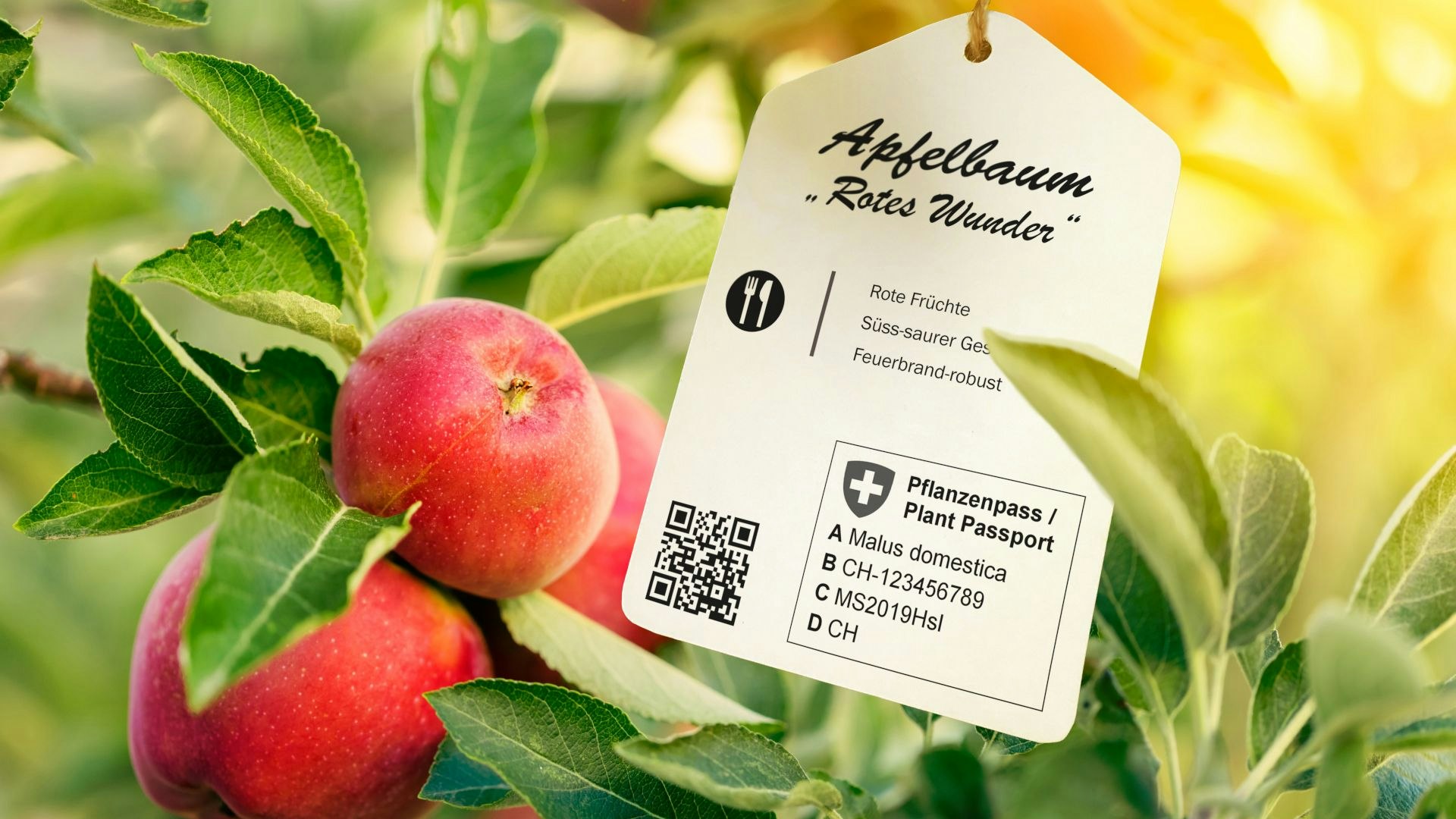
The most important information in brief
- The plant passport confirms to the recipient that the plants are free of quarantine organisms and that the regulations for regulated non-quarantine organisms are being adhered to.
- Companies must have the proper authorisation in order to issue plant passports.
- Regulated goods imported from the EU for personal use in personal luggage do not usually require a plant passport.
- Companies that importing, exporting or distributing plants that require a phytosanitary certificate (non-EU countries) or a plant passport (Switzerland and EU countries) are subject to the mandatory registration.
The plant passport system
Purpose of the plant passport
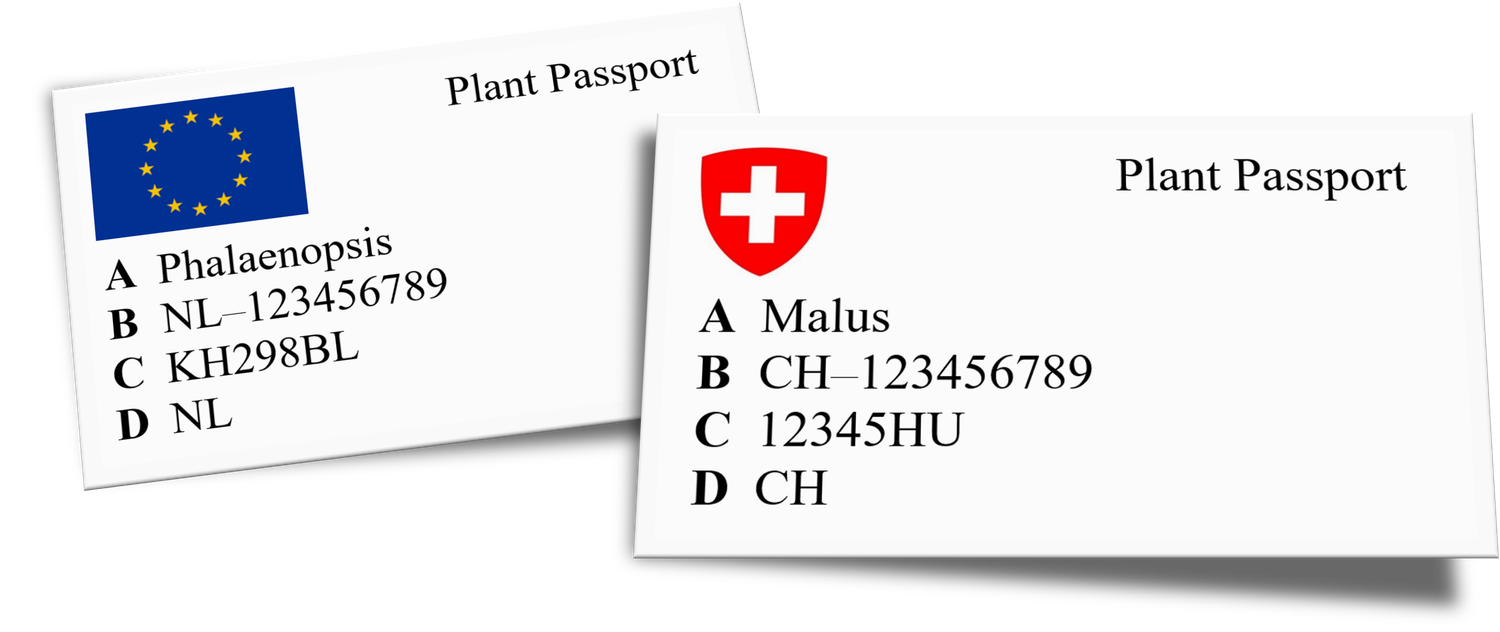
The plant passport also allows the plant goods to be traced in both directions along the entire trade chain. If a pest or disease infestation occurs in the trade chain, the origin can be traced back to the production plot of the goods. Conversely, plants that have already been traded and may have been infested can also be quickly located. This stops the spread of the pests or pathogens and prevents further damage.
The following goods require a plant passport
Plants
- Plants and parts of plants (other than seeds) which are intended to remain planted, to be planted or to be replanted, regardless of the botanical species – for example, pot plants, plant arrangements in bowls, seedling, cuttings, tissue cultures, bulbs, tubers, etc.
- Seeds of certain species (see below)
- Citrus fruits with leaves and peduncles
- Wood obtained from Juglans (walnut), Platanus (plane) and Pterocarya (wingnut)
- Plants and parts of plants not intended for planting (other than their fruits and seeds) of the following genera: Choisya (Mexican orange) and its hybrids; Citrus (citrus plants), Fortunella (kumquat), Poncirus (trifoliate orange) and their hybrids (incl. fruits with leaves and peduncles); Casimiroa, Clausena, Murraya (orange jasmine, curry tree), Vepris, Zanthoxylum and Vitis (grapevine)

Seeds
A detailed overview can be found in the document ‘List of seeds that require a plant passport’.
A plant passport is required in the following situations
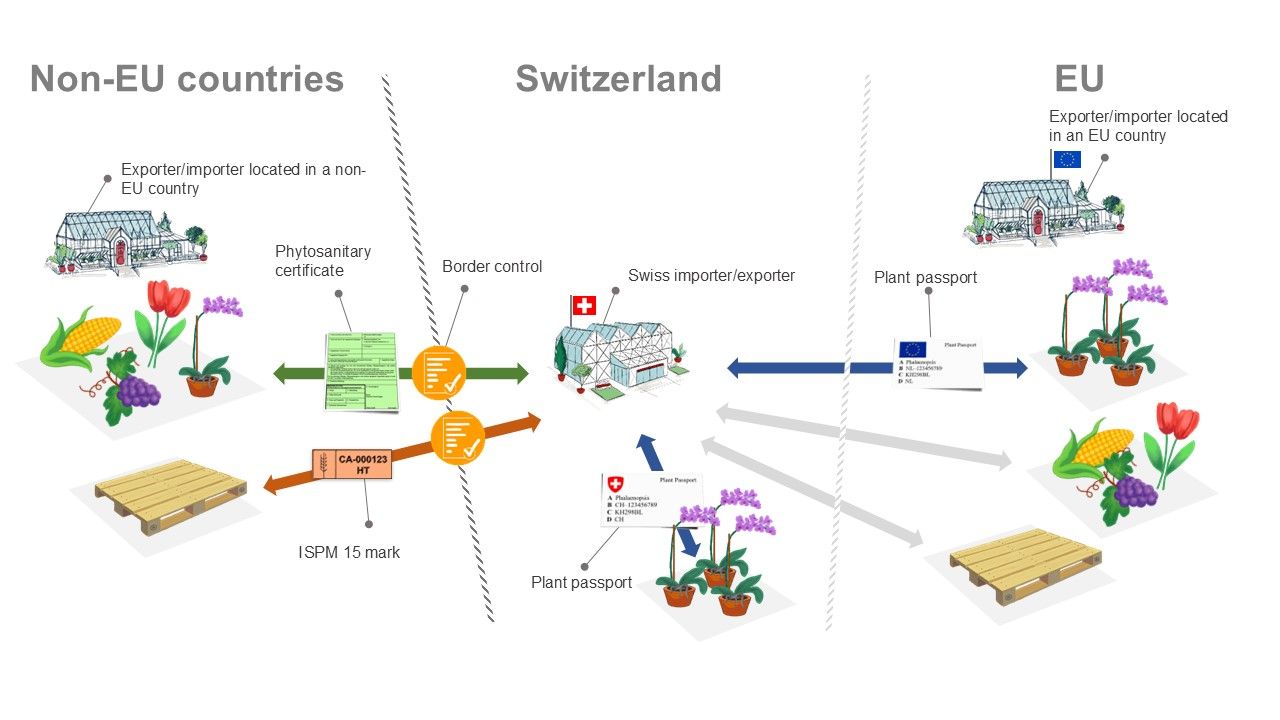
A plant passport is required for the supply (commercial or non-commercial) of regulated plant goods within Switzerland and for exchanges with the EU.
The plant passport must be affixed visibly and permanently to the trading lot or to the individual product before the goods are placed on the market. In this way, the plant passport physically accompanies the goods along the trade routes.
Different provisions apply to imports and exports to and from non-EU countries. In this case, plant material requires a phytosanitary certificate. Under certain circumstances, imports or exports may be completely prohibited. These provisions are explained under Importing plants and Exporting plants.
Good to know
- In phytosanitary terms, the Canary Islands, Ceuta, Melilla and the French overseas departments and territories are considered non-EU countries.
- Since 1 January 2021, the United Kingdom (with the exception of Northern Ireland) is considered a non-EU country for the import and export of plant products.
Exemptions from the plant passport requirement
Sale to private individuals
As a rule, a plant passport is not required if goods requiring a plant passport are sold directly to persons who will not use them for commercial or professional purposes (e.g. hobby gardeners). However, there are exceptions in the following cases:
- Distance sales: If goods are ordered via distance communication media such as the internet, telephone, fax or catalogue and delivered by post or courier service, a plant passport is required. In online trading, a plant passport is therefore generally required for regulated goods. However, if the goods are ordered online or by telephone and then picked up in person, for example in the case of ‘Click and Collect’, the plant passport requirement does not apply.
- Protected zones: When transporting certain goods to a protected zone, as well as when handing them over within a protected area, the plant passport requirement also applies to private individuals. However, there are currently no protected zones Switzerland.
Tourist traffic
Plant passports are generally not required for regulated goods that are brought in from the EU in personal luggage for private personal use.
Private exchange within Switzerland
In Switzerland, a plant passport is generally not required when private individuals exchange plants and parts of plants free of charge for planting and for non-commercial use. This also applies if the exchange takes place via means of distance communication (e.g. internet platforms).
Online plant passport tool (plantpassport.ch)
The online plant passport tool (available in German, French and Italian) can help you find out whether the goods are subject to the plant passport system. If so, it also helps you select the appropriate type of plant passport.
Exemptions
The Federal Office for Agriculture (FOAG) and the Federal Office for the Environment (FOEN) or the national plant protection organisation of the destination country may, on request, grant exemptions from the applicable provisions for certain purposes:
- Import from EU countries and placing plant products on the market within Switzerland: Exemptions from the plant passport requirement can be requested for research, diagnosis, variety selection and breeding, conservation of directly endangered phytogenetic resources and education, as well as in cases of acute supply shortages of a commodity.
- Handling of quarantine organisms (e.g. import and transfer) is also subject to exemptions. To apply for an exemption, complete the relevant form under ‘Forms’ below.
Online check for plant passport requirements
You can use the online plant passport tool (plantpassport.ch) to check in just a few steps whether you require a plant passport based on goods type, customer and sales method (e.g. distance sale). If a plant passport is required, the tool will display the appropriate type of passport.
Go to the online tool: www.plantpassport.ch
If you have any further questions or anything is unclear, please contact the Swiss Federal Plant Protection Service (SPPS): phyto@blw.admin.ch
Authorisation for issuing plant passports
Companies can apply for authorisation to issue plant passports. Plant passports can only be issued by authorised companies and the Swiss Federal Plant Protection Service (SPPS).
Authorised companies compliance with the conditions for authorisation is regularly checked. Companies that produce goods for which a plant passport is required must notify the SPPS each year of the relevant production plots, production units and the goods produced there. In addition, all authorised companies are required to maintain a list of purchases and sales.
You can use this form to apply for authorisation to issue plant passports (form only available in German).
User manual for the plant passport system
The manual (available in German, French and Italian) provides comprehensive information on the plant passport system. It is intended primarily for professionals who issue plant passports and require extensive information on the subject. Other professionals and interested individuals will also find useful information about the plant passport and the system behind it. The manual contains background knowledge as well as detailed explanations of the legal provisions and their practical implementation.
Plant Passport Newsletter
The Plant Passport Newsletter provides regular updates on important regulations and developments in the plant passport system.
Subscribe to the Plant Passport Newsletter (available in German, French and Italian)
Mandatory registration of companies
Since 2020, companies must register with the SPPS if they import, export or distribute plant products in Switzerland that require a phytosanitary certificate (non-EU countries) or a plant passport (Switzerland and EU). International passenger and freight transport companies, postal services and companies that sell their products using means of distance communication such as e-commerce are also subject to this registration requirement.
The aim of the mandatory registration of companies is to provide businesses with information about new phytosanitary regulations. The SPPS also provides information about potential hazards, such as the outbreak of a quarantine organism.
International airports, transport companies and postal services, as well as companies that offer goods by means of distance communication, must make information available in the form of posters or flyers at suitable locations and on their websites.
Frequently asked questions
Further information
The FOAG provides a reduced English-language version of its website that does not include all further information such as documents, legislation or links. These can be found on the pages in the three official languages (German, French and Italian).
Index
Related topics
Contact for questions
Swiss Federal Plant Protection Service SPPS
Schwarzenburgstrasse 165
Switzerland - 3003 Bern